When our group finished our City of Mist campaign, I realized I had a lot of feelings about the system, both good and bad. We came in as D&D players and spent the first few months trying to figure out what we were doing. I’d still recommend it, with a few asterisks.
For about a year and a half I played Mira Eros in our campaign, Sons of Catalina. She was a hematology doctor whose rift was Dracula. I wasn’t the MC, so this is mostly a player’s take, but I did a lot of digging into the rules along the way.
Characters That Grow Up (and Sometimes Die)
In most games I’ve played, your character’s growth lives in your backstory and in your head while the sheet gets bigger numbers. City of Mist gives every character Mythos themes (the legend living inside them) and Logos themes (their everyday life). As the story pushes on those themes, some fade and get replaced with new ones, so the sheet ends up telling the story of who your character is turning into.
Mira started out with a Blood Doctor Logos theme, and most of her tags were about healing people. Then she died. Her Dracula rift brought her back, but it turns out the hospital isn’t super flexible about employees who don’t show up to work due to being dead. She lost her Blood Doctor theme and picked up a new Mythos theme, Not On My Watch, with tags about fighting back against the villains instead of patching people up afterwards. Nobody had to sit down and negotiate any of that. The story changed, and the mechanics were already pointed in that direction.
I do like to do things a little extra, so I made my own character sheets for Mira, printed them out, and laminated them for the table. Here’s the before and after (click either one to see it full size).
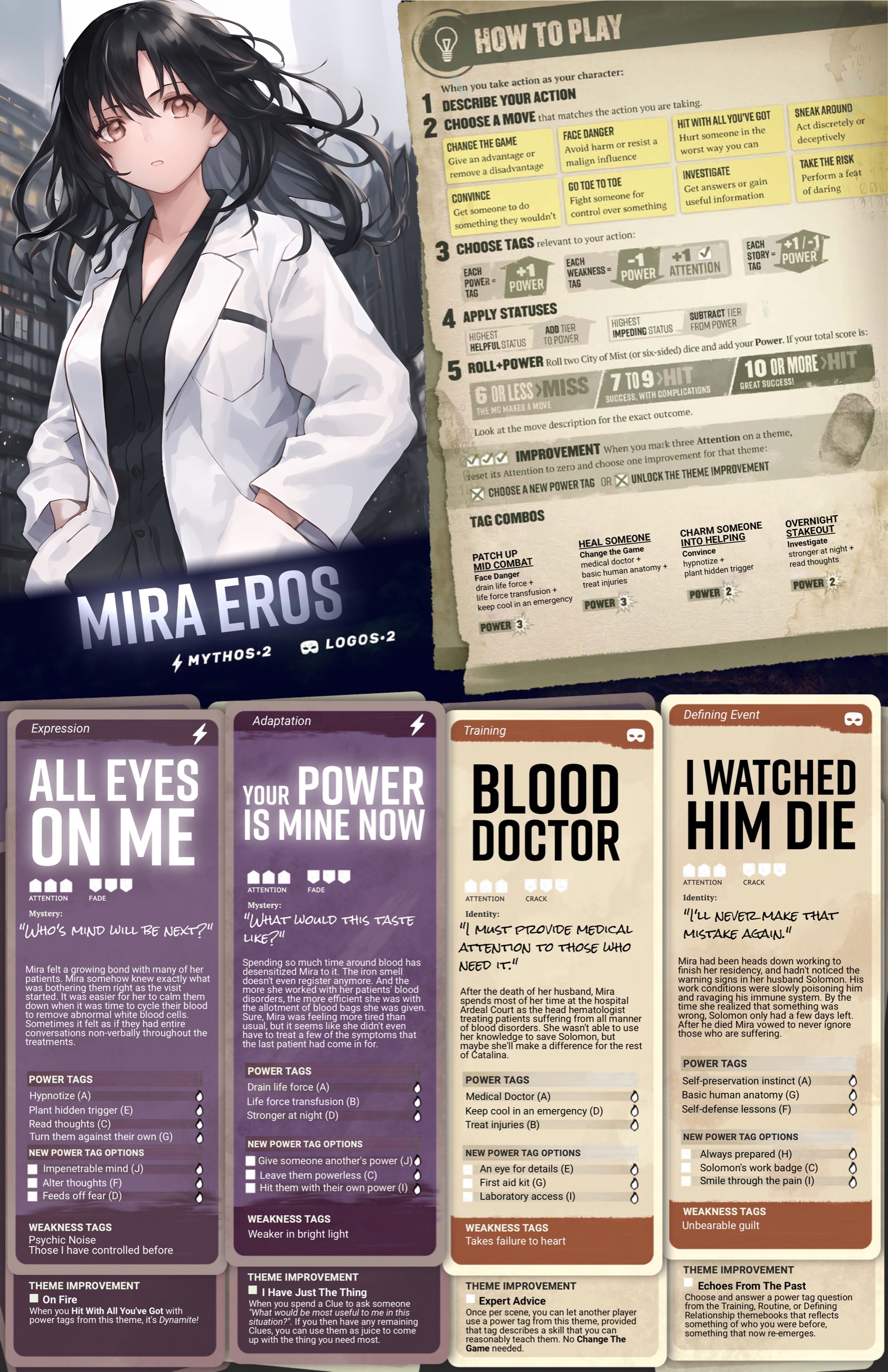
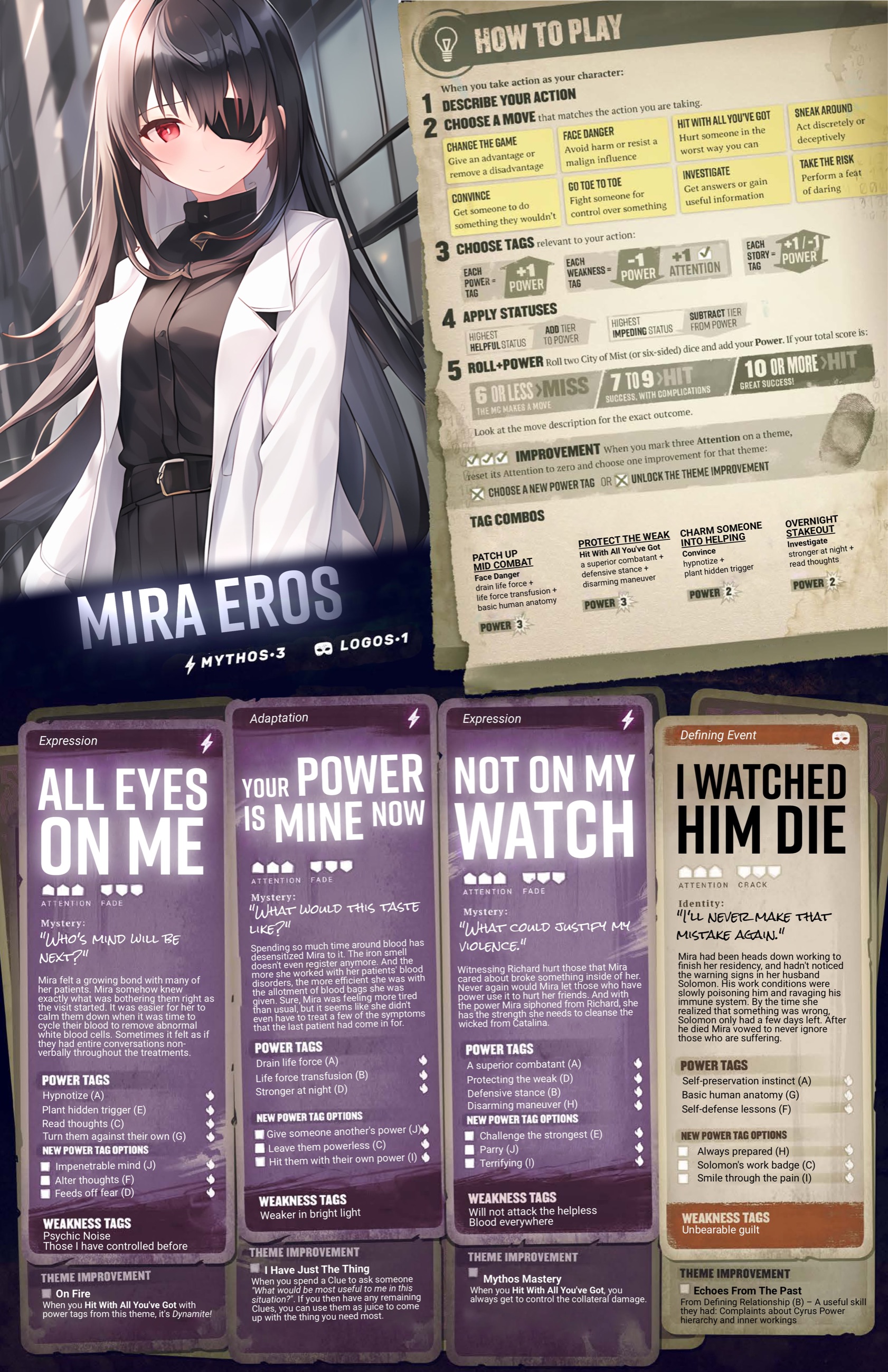
She went from Mythos 2 and Logos 2 to Mythos 3 and Logos 1. Blood Doctor, with tags like Medical doctor, Keep cool in an emergency, and Treat injuries, is gone. In its place is Not On My Watch, with A superior combatant, Protecting the weak, and Defensive stance, plus a new mystery: “What could justify my violence?” Even the tag combo cheat sheet I made for myself changed from Heal Someone to Protect the Weak.
Stop. Holding. Back.
Mira died because of one of my favorite mechanics. When a character wants to do something drastic beyond what the normal moves cover, they have to Stop Holding Back, and it costs something real. Mira used it in the crypts to save two people she cared about. It felt appropriately powerful while also having consequences, since she took a sword to the face and died.
For a few sessions after that I played Detective Flynn Perry, a hardboiled detective whose rift was Perry the Platypus. He joined the crew in time to help investigate Mira’s death, which is how they found out she had been reborn.
Flynn got a laminated sheet too. His Mythos themes were As Quiet as an Aquatic Mammal and Let Me Check My Utility Belt, his Logos themes were Never Without My Fedora and Knight in Sour Armor, and one of his weakness tags was Mounting paperwork, the most realistic thing about any detective I’ve played.
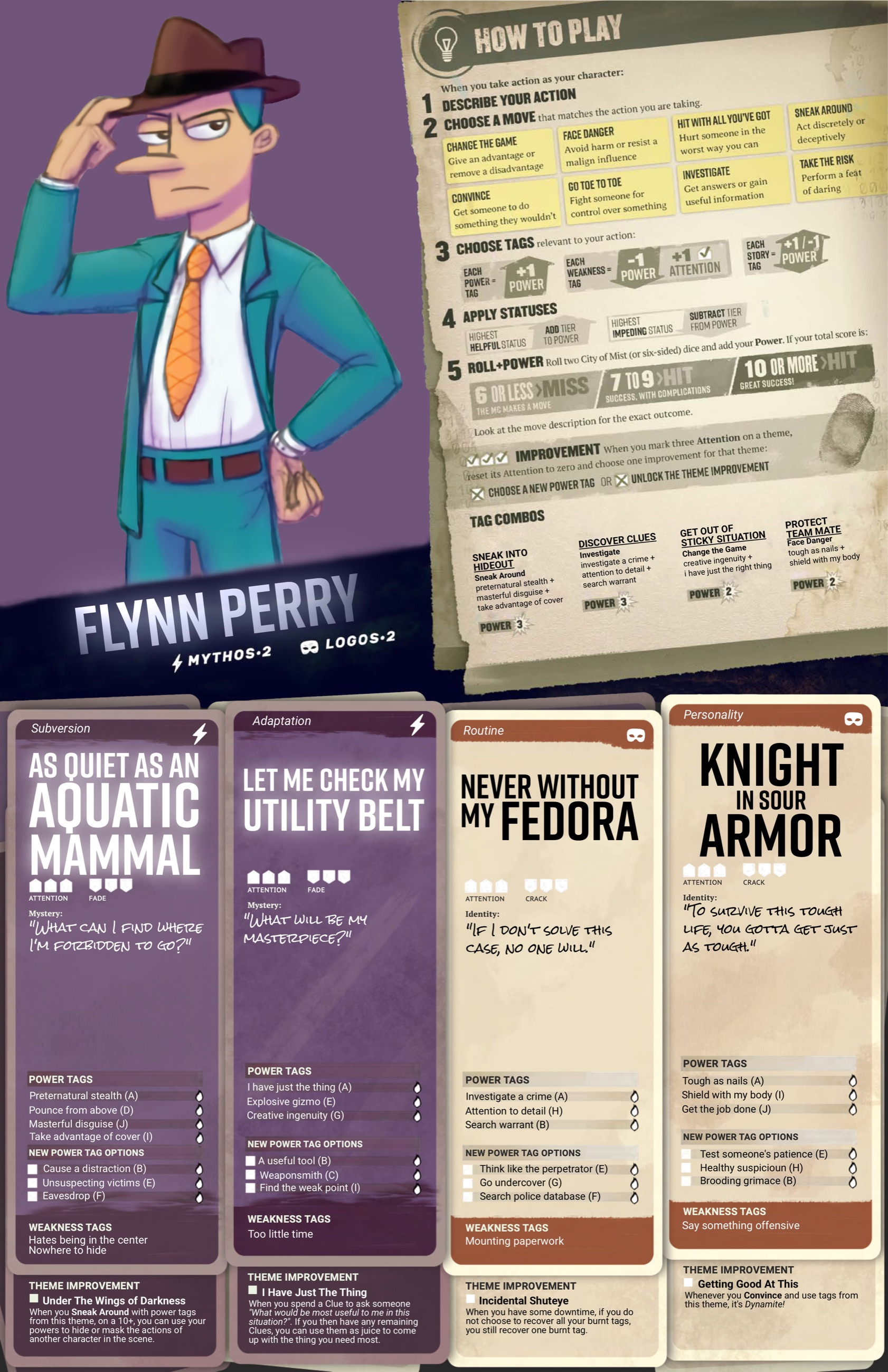 Flynn’s portrait: artwork by fuwa²kyara
That whole stretch was some of the most fun I’ve had at a table.
The Parts of Every Session I Looked Forward To
Each player got to open the session with a short monologue moment for their character, which meant everyone got the spotlight at least once a session. The threads we started in those monologues kept getting picked up later.
Our table added a rule that every monologue came with a song. I did three monologues for Mira, and I spent more time outside of sessions picking those songs than on almost anything else for the campaign, because I wanted each one to fit the story I was trying to tell.
- “Holding Out for a Hero” (the Aviators cover) kicked off the very first player monologue of the campaign. It introduced Mira and how being a vampire was getting in the way of her daily life as a doctor.
- “Poison” by Alice Cooper went with the monologue where I added Mira’s backstory: her marriage to Solomon Grunderson, who tragically died of radiation poisoning while working for a corporation that turned out to be part of the big bad of the campaign.
- “ONE MORE TIME” by blink-182 was for a monologue where Mira tried to come to terms with whether the golem we had recently fought had been her husband, while also having to keep raiding the hospital’s blood bank to keep her vampire urges under control.
The songs did a lot of the heavy lifting. Even when a monologue was short, the song set the mood for the whole session.
At the end of each session we did Geeking Out, where the players share what they loved about the session and about each other’s characters. I already do something like this in every campaign I run, called Stars and Wishes, where everyone shares what they liked about the other players so the good stuff keeps happening next time. Finding it built into a rulebook made me pretty happy.
The crew theme, which tracks how the group grows together, felt more like bookkeeping. Ours ended up as a tally at the end of each session, and it’s the part I’d trim if your group wants to keep things lighter.
Unlearning D&D
The hardest part for our group was unlearning our D&D habits.
In D&D, if you miss an attack you swing again next turn. In City of Mist, you can’t repeat an action using the same tags unless the situation has changed, so every action needs to leave a path forward whether you succeed or fail. “I attack the monster” isn’t enough on its own. You have to figure out how your action changes the scene, so that if you need to attack the monster again, it’s because the story has moved forward.
Combat sits somewhere between the grid-and-hit-points tactics of D&D or Pathfinder and pure narration, and it took us a while to get comfortable there. (I wrote about some of our early struggles in Investigating Core Moves in City of Mist.)
Figuring out tags and statuses came next: which tags apply to what you’re doing, how statuses build up, and how all of it changes the dice. That took a few sessions of working it out together.
Some Things to Know Going In
The MC does a lot of legwork. Our MC used the Iceberg method the book lays out for building mysteries, and he liked the system, but I don’t think he’d want to run another full campaign of it. He’d rather take the things that make City of Mist unique and bring them into other systems.
The rulebook layout. It isn’t the worst rulebook we’ve tried to muddle through, but the things you need to look up are often in different chapters when they probably should’ve been next to each other. By the end we had twenty-plus sticky notes poking out of our hard copies and still mostly searched the PDFs, because the computer was way faster than flipping around the book.
It takes a while to click. If your group is used to a fight every session with a clear tactical puzzle, the first few sessions will feel a little strange.
Where I Landed
I’m really glad I played a campaign of City of Mist. Characters whose sheets change with the story, the opening monologues, and Geeking Out are things I’ll keep thinking about in every game I play or run. I’m looking forward to whatever the designers make next, and I hope it comes with a simpler rulebook.
Play It If…
- You want characters whose growth shows up on the sheet, not just in the backstory
- Your group likes mysteries, investigation, and slow-burning reveals
- You want to try a narrative system that still has some structure to it
- Your MC enjoys improvising and building a mystery from the ground up
Skip It If…
- You want tactical combat with a grid and hit points
- Your MC wants a game they can run with little prep
- Your group gets frustrated hunting through a rulebook, or you can’t get the PDF